Biographical Sketch: Aaron Markowitz studies levitated optomechanics and precision measurement, with a focus on experimental tests of the quantum nature of gravity. At Yale, Dr. Markowitz works in Prof. David Moore’s group, where Dr. Markowitz built and operates a magneto-gravitational trap for levitating diamagnetic particles like diamond in high vacuum.
Aaron Markowitz completed a B.A. in Physics and Mathematics at Harvard University in 2016 and a Ph.D. in Physics at Caltech in 2023 under the supervision of Prof. Rana Adhikari. Thesis work spanned silicon microfabrication, cryogenic mechanical loss measurement, Bayesian inference for material characterization, and the design and commissioning of a tabletop phase-sensitive optomechanical amplifier.
Outside the lab, Dr. Markowitz seeks a sense of wonder and connection through community organizing and hiking.
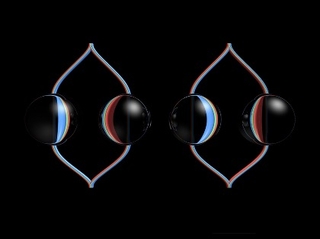
Research: Dr. Markowitz’s current work focuses on microdiamonds hosting single nitrogen-vacancy (NV) centers — the spin degree of freedom needed to witness gravitationally mediated entanglement between two nearby particles. A successful observation would exclude most semiclassical gravity models, providing strong evidence that gravity is quantum mechanical. The dominant obstacle is electrostatic interactions, particularly the electric dipole moment of the levitated diamond, which are expected to swamp the gravitational signal; characterizing and suppressing these backgrounds is a central focus of the group’s current efforts. This work is part of the MAST-QG collaboration (Macroscopic Superpositions Towards Witnessing the Quantum Nature of Gravity), which aims to test the QGEM protocol (quantum gravity-induced entanglement of masses).
Dr. Markowitz is contributing to MAST-QG’s experimental design efforts, helping chart a roadmap from the current generation of preparatory experiments toward a purpose-built apparatus targeting the gravitational entanglement signal directly. Dr. Markowitz’s broader interests include complex interferometer topologies and feedback control for quantum-limited sensing.
Education:
Ph.D., Caltech, 2023 (Prof. Rana Adhikari, advisor)
B.A. in Physics and Mathematics, Harvard University, 2016