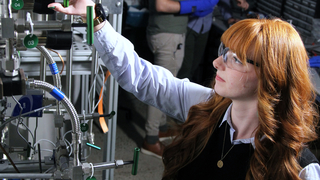
Biographical Sketch: Molly Watts is a physics Ph.D. candidate in Professor David Moore’s lab, where she develops precision sensing techniques for rare-event detection in nuclear and particle physics. Her current work focuses on mechanically probing the collective effects of radioactive decay, with the longer-term goal of extending these methods to directly detect neutrino recoil.
Molly received her B.A. in Physics from Columbia University in 2020 and first became involved with nEXO, a proposed search for neutrinoless double-beta decay, through a SULI internship at Brookhaven National Laboratory. Before turning to physics, she studied and worked in contemporary art, with particular interests in aesthetic theory and philosophy. In 2022, she co-founded Yale’s History and Foundations of Physics Group (HoFoP), developing interdisciplinary programming across physics, philosophy, and the history of science. In spring 2027, she will extend that work by co-teaching a graduate course at the Yale School of Art exploring connections between quantum physics, artistic practice, measurement, and physical reality.
Molly is also active in physics education and mentorship. She served for two years as co-chair of Yale’s Gender Representation in Physics (GRiP) group and currently co-chairs the Yale Physics Professional Development Organization (YPPDO). Through these groups, she has organized speaker series and alumni panels connecting students with science journalists, physicists, and industry professionals. She also developed hands-on physics demonstrations and outreach activities for K–12 students in New Haven, including through Yale Pathways to Science.
Research:
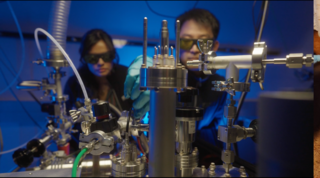
Molly leads the experimental TFINER (Thin Film Isotope Nuclear Engine Rocket) effort at Yale, a NASA NIAC project developing a deep-space propulsion concept based on the collective recoil from nuclear decays. Building on the Moore group’s mechanical detection of individual nuclear recoils, she is developing a diamagnetically levitated sensor to measure the collective recoil force and charge changes produced by many decays. Her work includes the design and construction of the experimental apparatus and optical readout, characterization of mechanical and electromagnetic backgrounds, and development of thin-film sails. Beyond testing the propulsion concept, these techniques could enable measurements of neutrino recoil from polarized nuclei.
Molly’s work on nEXO explores how improved light detection and analysis can strengthen background discrimination. She designed a cryogenic high-voltage system for characterizing SiPMs under nEXO-like conditions and developed optical simulations and analysis techniques that use spatial patterns of scintillation light to identify radon-induced backgrounds that evade conventional event reconstruction. Her recent work demonstrates that this light information provides discrimination power beyond standard analysis cuts.
Education:
Ph.D. in Physics, Yale University, in progress (Prof. David Moore, advisor)
B.A. in Physics, Columbia University, 2020, cum laude
Honors & Awards:
D. Allan Bromley Fellowship, 2026
NSF Graduate Research Fellowship, 2023
Selected Publications:
M. P. Watts on behalf of the nEXO Collaboration, “nEXO photon detection system and read-out electronics,” JINST 20, C06009 (2025).
Article
G. Afek, F. Monteiro, B. Siegel, J. Wang, S. Dickson, J. Recoaro, M. Watts, and D. C. Moore, “Control and measurement of electric dipole moments in levitated optomechanics,” Phys. Rev. A 104, 053512 (2021).
Article
A. Joseph, J.-P. Varela, M. P. Watts, T. White, Y. Feng, M. Hassan, and M. McGuigan, “Quantum computing for inflationary, dark energy, and dark matter cosmology,” arXiv:2105.13849 (2021).
Research Areas: Neutrinos & Fundamental Symmetries, Quantum Science & Sensing