Cantway invited by CERN to support ALICE detector operations and present thesis work
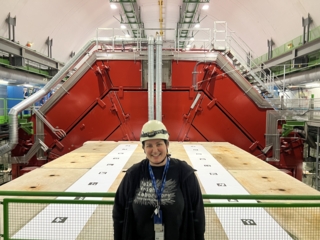
Image courtesy of Sierra Cantway.
Sierra Cantway, a graduate student in Yale Wright Lab’s Relativistic Heavy Ion Group (RHIG) was recently invited to spend three weeks at the European Center for Nuclear Research (CERN) to support detector operations there and present her thesis work. Cantway is advised by Helen Caines, Horace D. Taft Professor of Physics.
Cantway is a member of the A Large Ion Collider Experiment (ALICE) collaboration, which operates the ALICE detector on the Large Hadron Collider (LHC) particle accelerator at CERN. She contributes to the data-taking operations of the ALICE detector through her work on its ElectroMagnetic Calorimeter (EMCAL), a subdetector designed to measure energetic photons, light neutral mesons, electrons, and jets that are produced through high-energy collisions of particles in the LHC.
While at CERN, Cantway prepared the EMCal for a highly anticipated Pb–Pb run, where the LHC is used to collide lead (Pb) ions traveling near the speed of light to create a quark-gluon plasma (QGP). The QGP is an exotic high-energy-density state of matter predicted by the theory of the strong force—quantum chromodynamics (QCD)—to have existed in the first nanoseconds of the Universe. QCD governs the interactions between quarks and gluons (partons), which are the subcomponents of protons and neutrons.
Cantway explained why the QGP is so interesting to study, saying, “In analogy with electric charge, QCD applies to particles with a ‘charge’ property called color charges. Two defining features of QCD are asymptotic freedom, where quarks weakly interact with one another at high energy/small distances, and confinement, where, under normal conditions, quarks aren’t found in isolation, as it is more energetically favorable to create a new quark-antiquark pair as two quarks are pulled apart. Instead, quarks typically form color-neutral states called hadrons.”
Cantway continued, “These features suggest that at sufficiently high energies or densities, quarks and gluons can become deconfined, which occurs in the QGP. It was initially predicted that the QGP would behave like a weakly-interacting gas due to asymptotic freedom. However, somewhat surprisingly, modern descriptions of the QGP show it behaves most like a strongly-coupled liquid. This shows that the QGP is one of the best places to explore new regimes of QCD experimentally.”
Before the Pb–Pb run started, Cantway recovered electronics for the EMCal to ensure a large active detection area, which will lead to a higher quality and higher statistics data set to better study the QGP. As part of these efforts, Cantway participated in an access to the detector with other EMCal experts, where she traveled 184 feet below ground to the cavern that the ALICE detector is situated in.
Cantway said, “It was amazing to see the ALICE detector in person for the first time as part of that access. I could finally see with my own eyes the EMCal detector that I had been working on remotely throughout my Ph.D. I kept thinking, ‘Look, there’s that section of the detector I worked on the other day!’”
Now that the Pb–Pb run has begun, Cantway continues to support EMCal operations from Yale by serving as an expert EMCal detector on-call, remotely resolving any detector issues as they arise.

Image courtesy of Sierra Cantway.
While at CERN, Cantway also presented her thesis work, which focuses on jets, in an overview talk on “Identified light-flavor particles in jets” at the 2025 ALICE Physics Week meeting and in a poster on “Measurements of pions, kaons, and protons in jets and the underlying event in pp and Pb-Pb collisions with ALICE” at the LHCC students’ poster session.
Cantway said, “Occasionally, high-energy partons will interact with one another at the beginning of the lead ion collision before the QGP is formed. These partons then travel through the QGP medium, interacting with the QGP as it evolves since they both have color. Eventually, these partons combine into hadrons, creating a narrow shower of particles called jets. This entire process makes jets excellent probes of the QGP, capable of revealing the QGP’s properties and how partons interact with it.”
Cantway continued, “We see this experimentally by observing how various properties of these jets are modified for jets in the QGP compared to jets in vacuum, typically measured as jets produced in collisions of protons. In my case, I examine how the types of particles in these jets are influenced by the QGP.”
Cantway’s thesis results provide the first evidence that the particle composition in jets is modified by the QGP, as was predicted by state-of-the-art models.
Cantway said, “We can compare our measurements to these models to better pin down how much of these modifications come from jets being modified by the QGP compared to jets modifying the QGP itself as they pass through it. This is an open and challenging question for nearly all measurements of jets in the QGP, so it is really exciting that we can use these identified particles in jet measurements to make meaningful progress on this question.”
Reflecting on her overall experience at CERN, Cantway said, “I had a great time while I was at CERN, and I’m so glad I was invited to go there! It was very helpful for me to be there in person to prepare the EMCal for the Pb-Pb run; participate in the excitement for the start of the run; and discuss my thesis work and my ideas on future directions of these identified particles in jet measurements with the experts from across the field there.”