Wright Lab scientists develop and lead experiments to further our understanding of the Universe, from the most elementary particles to the evolution of the cosmos at the largest scales.

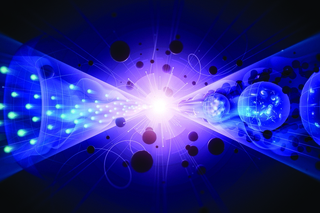
Research & Development
Wright Lab supports a broad research program in experimental nuclear physics, particle physics, and astrophysics, with particular emphasis on instrumentation development and quantum sensing for fundamental science.
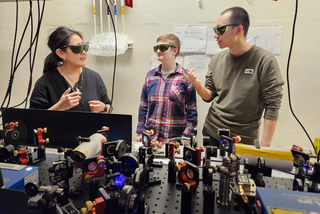
Preparing Future Scientists
Through hands-on research experiences, workshops, mentoring, scientific seminars, and career development activities, we train the next leaders in science and technology with a broad set of technical and management skills.
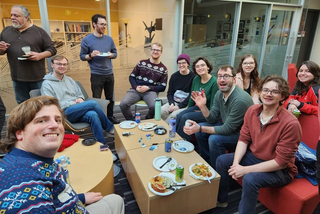
Research Community
Wright Lab is committed to fostering community among all students, staff, and faculty. Our community’s goal is to provide a safe, supportive, and productive environment for research, teaching, and mentoring.
Exploring Fundamental Physics of Quantum & AI
We lead a variety of experiments and efforts to develop quantum sensing tools and techniques for fundamental science.
We are engaged in a diverse spread of artificial intelligence, data science, and machine learning initiatives to enhance our research, teaching, and general productivity.
Upcoming Events
Subscribe to “Wright Lab Events” (1-5x/week) or “Wright Lab News” (1-5x/year) for updates on events & news.
News
-
Congratulations to Wright Lab Class of 2026 graduates!
Wright Lab congratulates our graduating students in the class of 2026.
-
A massive neutrino experiment is taking shape in an abandoned gold mine
DUNE will study nature’s most mysterious particle a mile beneath South Dakota’s Black Hills and will potentially reveal the origins of matter.
-
Breakthrough Prize in Fundamental Physics Awarded to Muon g-2 Collaborations at CERN, Brookhaven National Laboratory, and Fermilab
Yale physicist Satish Dhawan was honored as a living contributor. Vernon Hughes (1921-2003) was a leader in the second generation of the experiment.


Funding
Wright Laboratory gratefully acknowledges support from the Alfred P. Sloan Foundation; the Department of Energy, Office of Science, High Energy Physics and Nuclear Physics; the Gordon and Betty Moore Foundation; the Heising-Simons Foundation; the John Templeton Foundation; the Krell Institute; the National Science Foundation; the Simons Foundation; and Yale University.